



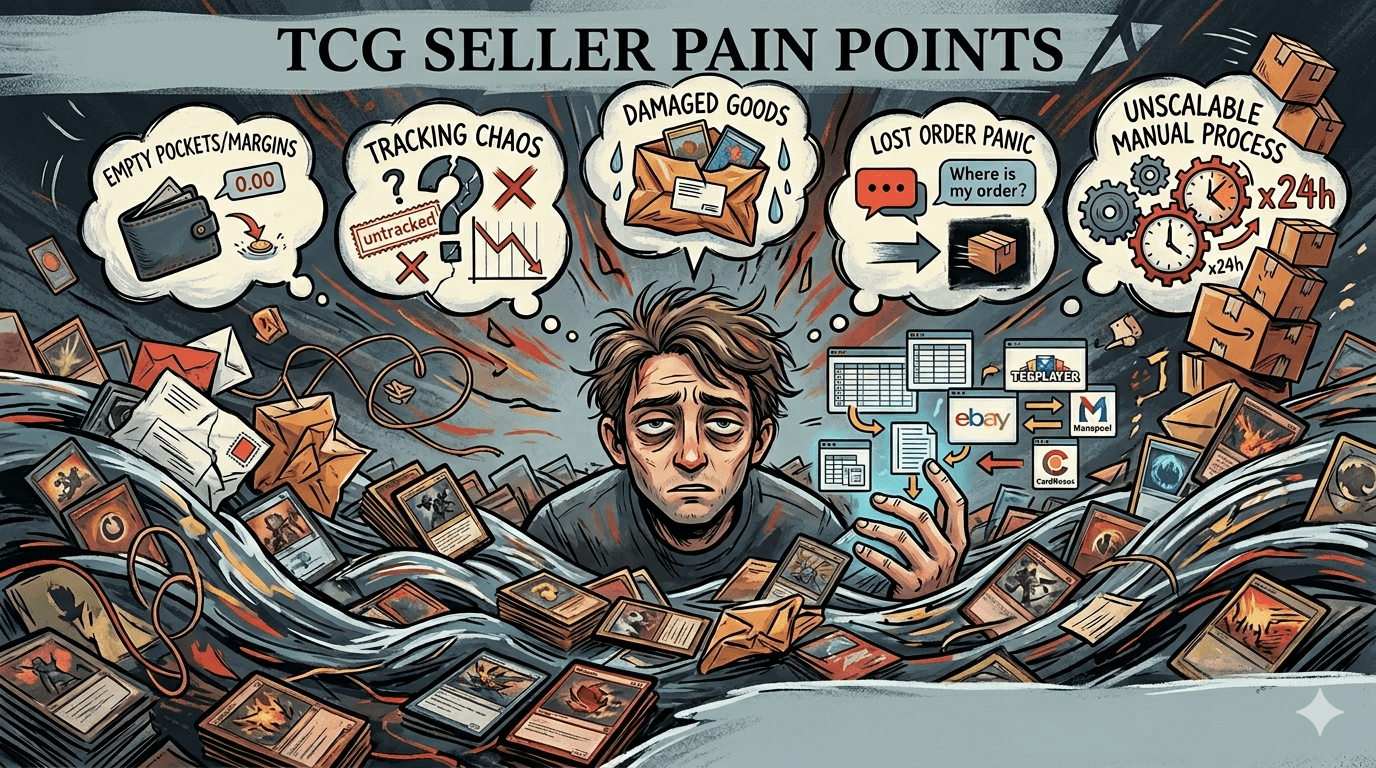
Shipping is one of the highest-friction parts of running a TCG selling business. The margins on individual cards are thin, the rules vary by marketplace, and one bad week of lost orders can erase weeks of profit. This guide covers the 6 most common shipping pain points for TCG sellers and gives direct, practical answers.
The 6 Biggest Shipping Pain Points for TCG Sellers
1. Profit margins disappear on cheap singles. Low-dollar cards shipped individually leave almost nothing after postage, packaging, and marketplace fees. The sellers who make it work do so through volume, combined orders, and buying inventory at prices that leave room for the full landed cost — not just the card price.
2. The tracking threshold is hard to figure out. Add tracking to everything and low-value orders become unprofitable. Add no tracking and one bad week of INR claims is a problem. The right answer is a defined threshold — a specific dollar amount where tracking becomes mandatory — and sticking to it consistently.
3. Packaging decisions are inconsistent. Most damage complaints trace back to one of four causes: loose cards inside the package, no rigid support, overstuffed envelopes, or moisture exposure. Standardizing by order tier (cheap single, multi-card, high-value) removes the guesswork and makes the process repeatable.
4. Lost order responses are reactive instead of proactive. Sellers without a written policy end up making emotional decisions — refunding one buyer quickly, arguing with another, losing track of a third. A simple written process (check tracking, confirm window, contact buyer, then refund or reship based on pre-set criteria) makes the outcome predictable.
5. Label printing and tracking upload eat hours every week. Buying a label from one tool, copying the tracking number, switching to TCGplayer, finding the order, pasting the number — done one order at a time. At 20 or 30 orders a day, that adds up to hours weekly.
6. Fulfillment does not scale without a system. Sellers who do everything manually hit a ceiling. Past a certain volume, the work expands to fill every available hour. The fix is not more time — it is batching, standardization, and removing the steps that repeat unnecessarily on every order.
Three Questions Sellers Ask Most
When should I add tracking?
The break-even point is different for everyone, but the logic is the same: compare your average monthly refund cost on untracked orders against the cost to upgrade those orders to tracking. If refunds cost more than the upgrade, lower your tracking threshold. If tracking costs more than the refunds you are preventing, your threshold is already fine.
On TCGplayer, part of the rule is already set for you: orders over $49.99 must be shipped with tracking, and orders over $20 should include tracking for seller protection.
What do I do when a buyer says the order never arrived?
Use a sequence. Check the order date, ship date, and tracking status first. Confirm whether the delivery window is still within a normal range. Ask the buyer to verify their address and check their mailbox. If the order is tracked, open a carrier inquiry if scans have stalled in a suspicious way. If it is untracked and clearly overdue, apply your pre-written refund or reship rule. For low-value orders, a fast refund usually costs less than the time spent on a long dispute.
How do I stop packaging damage complaints?
The goal is to prevent bending, moisture, surface scratching, and card movement inside the package. Sleeve every card. Use rigid support for singles and valuable cards. Seal the sleeve stack so cards cannot slide. Do not let the card move inside the holder. Most damage that arrives at the buyer's door started before the package reached the carrier — loose inside the envelope or overpacked in a way that created pressure points.
Automating the Fulfillment Workflow
The biggest time drain for most TCG sellers is not packing — it is the back-and-forth between tools. Buy a label here, upload tracking there, mark the order shipped somewhere else.
TCG Quick Ship was built specifically to remove those steps. It imports orders from TCGplayer, Manapool, CardNexus, and other marketplaces, generates labels in batch, and pushes tracking numbers back automatically. Sellers who switch from a manual workflow often describe it as the first time shipping felt like a routine rather than a project.
Read the Full Guide
The complete TCG Seller Shipping & Fulfillment Guide covers all 26 of the most common seller questions — including when to use PWE versus tracked shipping, how to set a refund policy, how to handle a major set release, and how TCG-specific tools compare to general shipping software.